

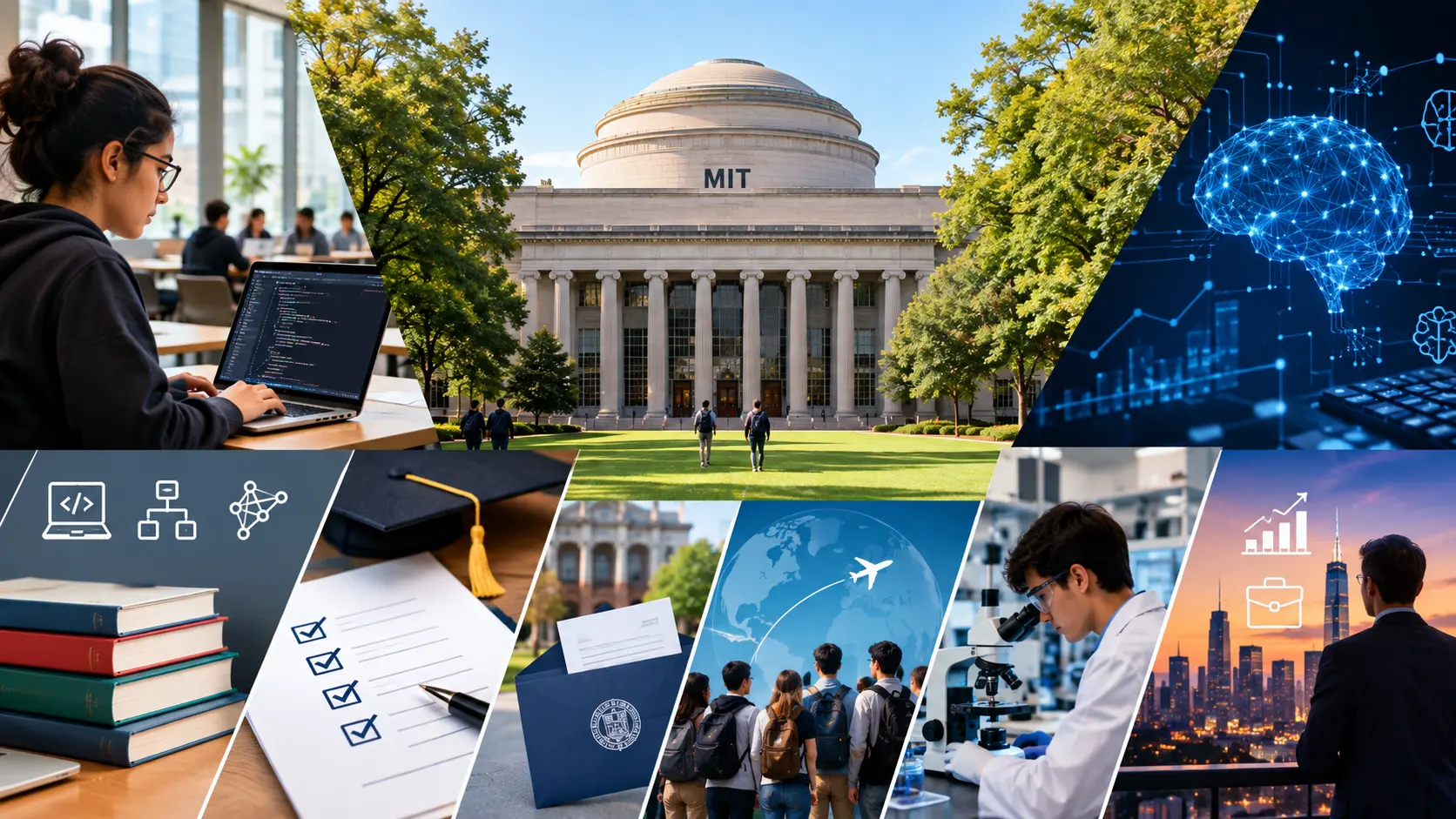
Choosing this field at a university like MIT is about much more than picking a degree title. Students researching the program often want to know what they will actually study, how MIT admissions work, which academic preparation matters, whether international applicants can receive financial aid, and what they can do after graduation.
This guide brings those questions together in one place, as a supporting resource for students who are already exploring MIT funding options and want to understand the academic side of the degree.
For students interested in financial support, read our related guide: Scholarship in MIT USA: The Complete Guide for International Students.
Important: MIT updates academic programs, admissions policies, testing requirements, and financial-aid information periodically. Always verify current requirements on MIT’s official websites before applying.
What Is Computer Science at MIT?
First-year applicants apply to MIT as a whole, not to a particular major — this is the single most important thing to understand before you go any further, and it’s worth stating clearly once here so the rest of this guide can build on it without repeating itself. Students normally begin undeclared and choose a major in the spring of their first year, with the option to stay undesignated a little longer. MIT also says the field of interest listed on the application has no bearing on the admission decision.
For students specifically interested in the traditional path, the core undergraduate route is Course 6-3: Computer Science and Engineering, offered through MIT’s Department of Electrical Engineering and Computer Science (EECS).
The current MIT catalog describes Course 6-3 as a Bachelor of Science in Computer Science and Engineering, built around software, computer systems, and theoretical computer science, with room to build depth through specialized tracks.
That distinction matters because “MIT CS” can mean more than one academic path. Depending on a student’s interests, related MIT programs include Artificial Intelligence and Decision Making, Computer Science, Economics, and Data Science, Computation and Cognition, and other interdisciplinary combinations.
So when researching an MIT computer science degree, look beyond the general phrase and identify the exact Course number that matches your goals.
Why Study Computer Science at MIT?
An education in this field at MIT combines mathematical foundations, computing theory, systems, programming, experimentation, and problem-solving rather than treating programming as an isolated skill.
Computer science at MIT admissions guidance also emphasizes a broader educational culture built around collaboration, initiative, hands-on creativity, curiosity, and applying knowledge to real problems.
For a prospective student, that can mean learning in several different ways:
- foundational lectures and problem sets
- programming and systems coursework
- project-based learning
- undergraduate research
- internships and practical experience
- interdisciplinary subjects
- independent projects
- collaboration with other students
MIT’s philosophy is often described through its “mind and hand” approach: theoretical understanding is paired with doing, building, testing, and solving practical problems.
This is one reason prospective applicants should evaluate the curriculum itself rather than relying only on the university’s reputation.
The MIT Computer Science Curriculum, Course by Course
This is the part most guides skip or keep vague — actual course numbers, in the order students typically take them, inside Course 6-3.
The current 6-3 degree structure includes General Institute Requirements plus a departmental program totaling roughly 180–198 units beyond the GIRs. Within that, the core computer science sequence looks like this:
| Course Code | Subject | What It Actually Covers |
| 6.100A (or 6.100L) | Introduction to Computer Science Programming in Python | First exposure to programming and computational thinking; often paired with a second intro subject in data science or computational science |
| 6.1010 | Fundamentals of Programming | Moves from basic scripting into structured software design and data structures |
| 6.1020 | Software Construction | Building larger, maintainable software systems — testing, specification, modularity |
| 6.1200 | Mathematics for Computer Science | Discrete math, logic, proofs, combinatorics — the theoretical backbone the rest of the major depends on |
| 6.1210 | Introduction to Algorithms | Algorithm design and analysis; searching, sorting, graph algorithms, complexity |
| 6.1220 / 6.1400 | Design and Analysis of Algorithms / Computability and Complexity Theory | Deeper algorithmic and theoretical grounding — what can and can’t be computed, and how efficiently |
| 6.1800 | Computer Systems Engineering | Operating systems, networking, and systems-level design |
| 6.1910 | Digital Systems Laboratory | Hands-on hardware/digital design; also satisfies the Restricted Electives in Science and Technology (REST) requirement |
Two subjects within the major are also designated communication-intensive (CI-M), on top of the CI-H subjects required through the HASS requirement — MIT treats technical writing as part of being a computer scientist, not an optional add-on.
Beyond this core, students choose electives across recognized tracks, including:
- Artificial Intelligence and Machine Learning
- Computer Systems (databases, distributed systems, networking)
- Theoretical Computer Science (algorithms, complexity, cryptography)
- Software Engineering (programming languages, software design)
- Human-Computer Interaction and Graphics
Related programs extend this further: Course 6-4 (Artificial Intelligence and Decision Making) is a separate Bachelor of Science built around algorithms for learning and reasoning, while other tracks combine computing with molecular biology, cognitive science, or economics.
A note on curriculum versions: students who started at MIT in Fall 2021 or earlier could choose between the 2017 and 2022 versions of the 6-3 requirements; anyone starting Fall 2022 or later follows the 2022 curriculum only. Course numbers and requirement units can shift between catalog years, so confirm the current chart on MIT’s official course catalog before building a multi-year plan.
Applying to MIT: How the Major Question Actually Works
Because MIT admits to the Institute rather than to individual departments, a few practical points follow from that:
- There’s no separate admissions checklist, GPA cutoff, or test score specific to this major
- You don’t need to have decided on it before applying — many admitted students switch into or out of the program after arriving.
- Naming your intended field of study helps admissions understand your interests in context, but doesn’t change the review process.s
- MIT’s guidance for first-year students confirms a major can be declared by the spring Drop Date of freshman year, with a final deadline by the end of sophomore year for undecided students.
Everything below — testing, academic preparation, essays, activities — is standard MIT admissions guidance that applies whether or not your interest is technical.
MIT Admission Requirements Relevant to a CS-Focused Applicant
MIT evaluates every applicant holistically and says it does not use a formula or publish an SAT/ACT cutoff.
Academic Preparation
MIT recommends a strong pre-college foundation to help students handle its rigorous curriculum and General Institute Requirements. For a student aiming at this field, that commonly means comfort with:
Mathematics: algebra, geometry, trigonometry, calculus where available, and increasingly advanced mathematical reasoning — this maps directly onto 6.1200 (Mathematics for Computer Science) later on.
Science: a rigorous science curriculum appropriate to your school system.
Programming: useful when available, but not a formal requirement — MIT does not check for a specific certificate or prior language.
Communication: writing and clear explanation matter throughout the degree, given the CI-H and CI-M requirements built into the major itself.
SAT and ACT
MIT currently requires the SAT or ACT for first-year and transfer applicants, accepting both paper and digital SAT formats, and does not require ACT writing/science or the SAT optional essay. It does not publish a cutoff or recommended score because it reviews scores in context.
For International Applicants
International applicants follow MIT’s standard international-applicant process rather than a separate technical-admissions channel. MIT provides English-proficiency testing guidance for applicants who have used English for fewer than five years or don’t speak it at home or school.
A Pakistani student, or any international applicant from a non-US curriculum (O/A Levels, IB, or a national system), should focus on:
- Strong, verifiable mathematics and science coursework
- Genuine programming or technical projects — not activities assembled purely for the application
- Problem solving through competitions, research, or independent work
- Clear written and spoken communication in English
- Reviewing MIT’s current English-proficiency guidance to see if it applies to your situation
MIT’s own guidance emphasizes initiative, hands-on creativity, curiosity, and meaningful engagement over a long list of unrelated activities.
What the Application Actually Contains
Requirements and deadlines shift by cycle, so always confirm on MIT Admissions directly. At a high level, applicants prepare:
- Academic record — secondary-school coursework, grades, and context
- Testing — SAT or ACT under MIT’s current policy
- Essays and short responses — several shorter pieces rather than one long personal statement, designed to reveal interests and personality
- Activities — up to four that matter most to the applicant
- Recommendations and school information
MIT’s 2026–2027 essay prompts include a question about which field of study appeals to the applicant most right now, and another about doing something different from what was expected of them.
What Students Actually Learn Beyond the Core Sequence
Once the foundational sequence (6.1010 through 6.1800, covered above) is done, students go deeper into specific areas:
Databases — storing, organizing, and querying information at scale.
Artificial Intelligence — machine learning, decision-making, and data-driven systems, often extending into Course 6-4 territory.
Human-Computer Interaction — how people interact with software, combining computing with user-centered design.
Computer Architecture — how processors and system components actually execute computation, connecting back to the EE side of EECS.
Someone interested in software development leans toward the software-engineering track; someone interested in AI moves toward 6-4-adjacent electives; someone interested in hardware pulls from the EE side; someone drawn to theory stays close to the 6.1200/6.1220 sequence; someone interested in people and technology moves into HCI. The exact selection depends on the current catalog, prerequisites, and scheduling — confirm details on MIT’s official course catalog rather than a secondhand list.
Research and Practical Experience
MIT highlights undergraduate research through the Undergraduate Research Opportunities Program (UROP), where students work directly with faculty on research projects. For students in this field, that can mean early exposure to AI, robotics, computer systems, computational biology, graphics, HCI, or theory — well before graduate school.
Students also build practical skills through internships, project-based classes, makerspaces, and student organizations, inside what MIT describes as a highly collaborative, hands-on learning environment.
Financial Aid: What International Applicants Should Know
MIT’s undergraduate admission is need-blind, and once admitted, MIT commits to meeting 100% of demonstrated financial need for all four years — for both domestic and international undergraduates. Aid is primarily need-based rather than merit-based.
For the 2025–26 academic year, MIT states that students from families earning under $200,000/year (with typical assets) generally attend tuition-free, and those under $100,000/year have a $0 parent contribution. Reconfirm these figures for the year you apply, since MIT’s methodology is reviewed annually.
International applicants apply for aid through the International Student CSS Profile, along with parental income documentation. Note the distinction between:
- MIT Scholarships — need-based aid that doesn’t need to be repaid
- External scholarships — funding from organizations outside MIT
- Family contribution — what MIT determines a family can reasonably pay after reviewing financials
There isn’t a scholarship specific to this major — funding works the same way regardless of which track a student ends up choosing. For the full breakdown, see our MIT scholarship guide.
Cost vs. What You Actually Pay
MIT’s published cost of attendance and your actual out-of-pocket cost are two different numbers. MIT calculates financial need using your expense budget and family financial information, then builds an aid package around demonstrated need. Before assuming the full sticker price applies to you, check both:
- MIT’s published cost of attendance
- MIT’s estimated aid contribution for your family situation
Career Opportunities After Graduation
Graduates of this program move into a genuinely wide range of paths:
Software Engineering — applications, infrastructure, developer tools, backend services, distributed systems.
AI and Machine Learning — roles building or researching intelligent, data-driven systems.
Data and Analytics — data engineering, computational analysis, technical decision systems.
Cybersecurity — security engineering, infrastructure and application security, building on systems coursework.
Computer Systems — operating systems, cloud infrastructure, distributed computing, networking.
Research — continuing into graduate study or research careers, particularly for students who engaged with 6.1220/6.1400-level theory.
Entrepreneurship — MIT’s hands-on, interdisciplinary environment supports students who want to build products or found companies.
A major doesn’t lock in a single career path — MIT’s own first-year guidance notes that a chosen major develops knowledge and skills without dictating a graduate’s eventual career.
Typical Roles
Software Engineer, Machine Learning Engineer, AI Engineer, Data Engineer, Data Scientist, Security Engineer, Systems Engineer, Research Engineer, Cloud Engineer, Backend Engineer, technical founder, or continuation into graduate study — with the specific role depending on coursework, internships, projects, and specialization rather than the degree title alone.
On Salary
MIT’s Student Financial Services reports an average starting salary of $145,820 for a graduating senior entering industry in 2025 — this is a university-wide figure across all majors, not specific to this program, and shouldn’t be quoted as a CS-specific number. Actual compensation varies by employer, location, specialization, and prior internship experience far more than by degree title.
Is It Difficult, and Is It Right for You?
Selectivity and day-to-day difficulty are two separate questions. MIT doesn’t publish a formula for admission chances, and the coursework itself is demanding — mathematics, systems, theory, and communication requirements all stack on top of each other.
MIT encourages students to explore, ask for help, and work collaboratively rather than expecting applicants to already know everything. A more useful question than “is it hard” is: do you enjoy the kind of mathematical, computational problem-solving this coursework actually involves?
A Practical Roadmap for Prospective Applicants
During secondary school: build strong mathematics and science preparation.
Learn programming: start with one language and focus on computational thinking rather than collecting languages.
Build real projects: create something that solves an actual problem or reflects genuine curiosity.
Explore beyond coding: AI, systems, robotics, algorithms, computational science.
Develop communication skills: practice explaining technical ideas clearly, in writing and out loud.
Prepare for standardized testing: factor SAT/ACT prep into your timeline given MIT’s current policy. (MIT Admissions)
Research directly from MIT’s own sites: Admissions, EECS, the Course Catalog, and Student Financial Services, rather than secondhand blog posts.
Build your application around real interests: MIT’s guidance consistently points to authenticity and initiative over a curated list of activities.
Common Mistakes to Avoid
Treating an unofficial SAT score as a hard cutoff — MIT publishes none.
Thinking programming alone is enough — mathematics, algorithms, systems, theory, and communication all carry equal weight in the degree.
Assuming every scholarship is merit-based — MIT’s undergraduate aid is need-based, covering 100% of demonstrated need for admitted students, including international applicants.
Using outdated information — testing policy, financial aid figures, deadlines, and course numbers all change between catalog years.
Choosing activities purely for the application — MIT explicitly advises picking what genuinely interests and challenges you.
International Applicant Checklist
Before submitting an application, confirm:
- Does your curriculum provide strong mathematics, science, and communication preparation?
- Have you checked MIT’s current SAT/ACT policy?
- Does MIT’s English-proficiency guidance apply to your situation? (MIT Admissions)
- Have you completed the current application and short-answer requirements?
- Can you clearly explain the activities that matter most to you?
- Can you demonstrate genuine technical curiosity through things you’ve actually built, researched, or contributed to?
- Have you reviewed MIT’s international financial-aid process rather than assuming you must self-fund the full published cost?
- Have you verified every deadline and requirement directly through MIT’s official pages?
Conclusion
This is not simply a programming degree. Course 6-3, Computer Science and Engineering, combines programming, algorithms, systems, theory, mathematics, specialized tracks, and communication requirements into one structured curriculum.
Admission runs through MIT’s general, holistic process, with the major selected after enrollment — and funding, for those who qualify, is need-based and covers up to 100% of demonstrated need regardless of which track a student eventually picks.
The most useful next step is reading MIT’s own curriculum, admissions, and financial-aid pages directly, rather than relying on rankings or a single “ideal applicant” profile.
Continue with our related MIT scholarship and financial-aid guide.
Frequently Asked Questions
What is MIT Course 6-3? MIT’s Bachelor of Science in Computer Science and Engineering — software, systems, and theoretical computer science, with specialized tracks in AI, HCI, and more.
What courses are in the curriculum? Starting with 6.100A (intro programming), the core sequence runs through 6.1010, 6.1020, 6.1200, 6.1210, 6.1220/6.1400, 6.1800, and 6.1910, followed by track electives.
Do I need a specific SAT/ACT score to get in? No published cutoff exists — MIT requires the SAT or ACT but reviews scores in context.
Can international students receive financial aid for this program? Yes — MIT meets 100% of demonstrated need for qualifying international undergraduates through the same need-based process used for every major.
What careers follow this degree? Software engineering, AI/ML, data, cybersecurity, systems, research, and entrepreneurship, with the specific role shaped by electives, internships, and projects rather than the degree title alone.