
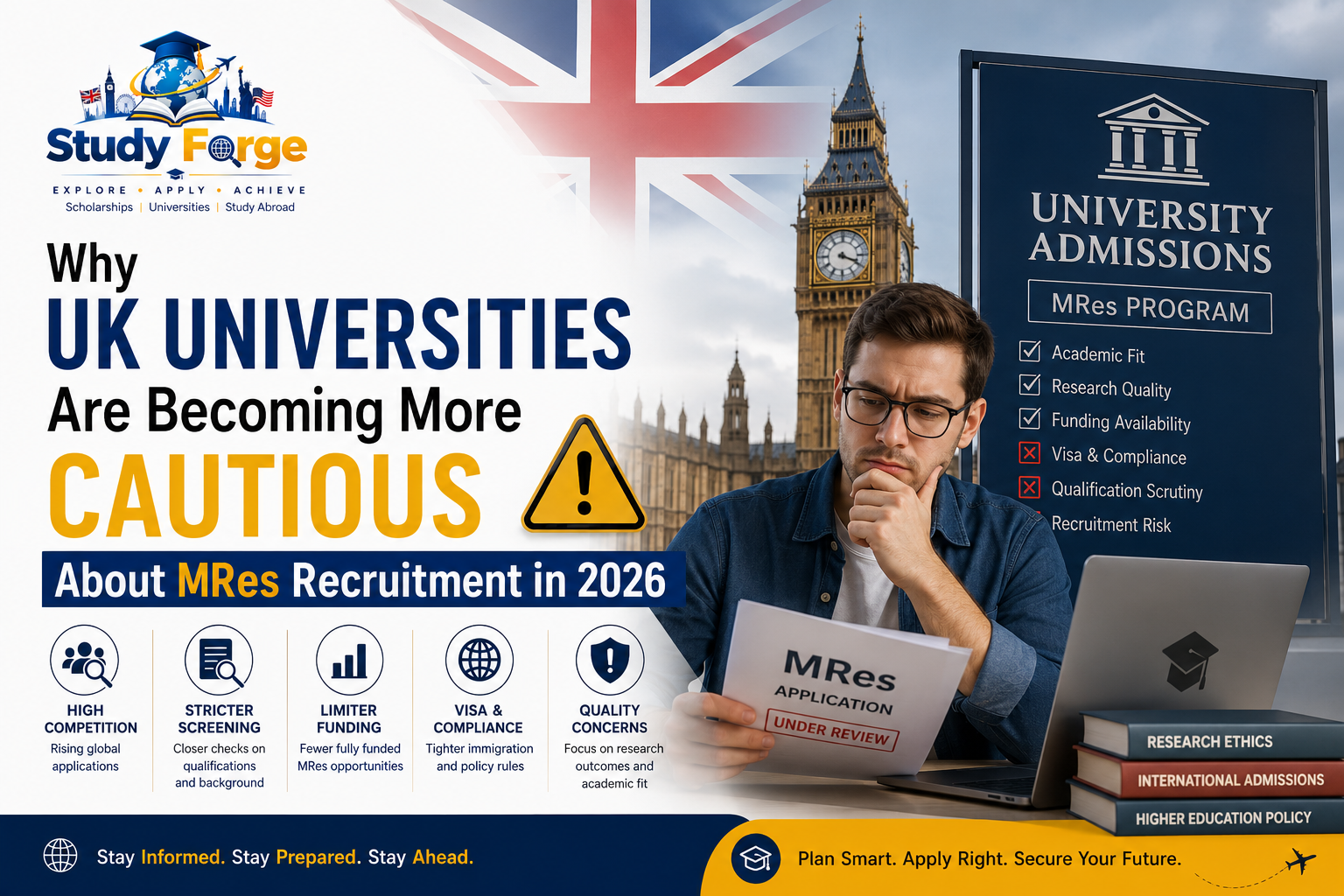
UK universities are tightening MRes recruitment because the qualification saw a sharp, sudden rise in international applications after research-based postgraduate courses were exempted from the January 2024 rule barring most taught postgraduate students from bringing dependants to the UK. That surge triggered closer scrutiny from the Home Office, which requires universities holding a student sponsor licence to demonstrate they are recruiting genuine students who complete their courses. In response, some universities have introduced earlier deadlines or paused recruitment for specific MRes intakes but the MRes as a qualification is not disappearing, and genuine research-focused applicants are still welcome across the sector.
Scroll through international education forums right now and you’ll find panicked threads claiming UK Master of Research (MRes) programmes are shutting their doors to international students. That’s not what’s actually happening and most of the coverage skips the one detail that explains everything: this isn’t about the MRes qualification losing value, it’s about UK universities protecting their sponsor licences under a tighter Home Office compliance regime.
I’ve gone through the actual immigration rule changes the January 2024 dependant restrictions, the Home Office’s sponsor compliance framework, and the confirmed Graduate Route reduction taking effect from January 2027 rather than repeating secondhand summaries. By the end of this article, you’ll understand exactly why MRes applications surged, why universities responded the way they did, and what it actually takes to get an offer in this more cautious environment.
How Different Groups Are Framing the MRes Situation
The Home Office’s framing: For the UK Home Office, this is a compliance story, not an academic one. Its sponsor licence framework requires universities to show low visa refusal rates, strong course completion, and genuine student engagement and a sudden spike in applications to any single course type is exactly the kind of pattern that draws scrutiny under that framework.
The university admissions framing: From the perspective of UK universities themselves, the caution isn’t about doubting genuine MRes applicants it’s about protecting their ability to sponsor any international student. A university that loses or has conditions placed on its sponsor licence puts every one of its international recruitment pipelines at risk, not just MRes.
The applicant-advisory framing: Scholarship and admissions trackers that follow UK postgraduate trends closely including sites like Scholarship Scanner, which monitors UK university funding and recruitment patterns frame the situation more practically: apply earlier, be ready for extra scrutiny, and lead with a genuine research rationale rather than a visa rationale.
The immigration-policy framing: Immigration law commentators tracking the broader reform agenda point out that MRes scrutiny is one small piece of a much larger tightening cycle that also includes the Graduate Route reduction confirmed for January 2027 meaning MRes applicants are being affected by policy currents well beyond the qualification itself.
All four framings point to the same underlying cause. The difference is simply whose risk each group is managing: the Home Office’s migration numbers, the university’s sponsor licence, the applicant’s odds of admission, or the sector’s reputation.
MRes vs. Taught Master’s (MSc/MA): The One Distinction That Explains Everything
The surface-level differences between an MRes and a taught master’s smaller class sizes, more independent study, a research proposal requirement all trace back to a single structural distinction: an MRes is assessed primarily through independent, supervised research output, while a taught master’s is assessed primarily through structured teaching, coursework, and exams. That distinction is also exactly why MRes courses were exempt from the January 2024 dependant restrictions that apply to most taught postgraduate courses the exemption was built around the research classification, not the subject area or university.
| Feature | MRes (Master of Research) | Taught Master’s (MSc/MA) |
| Core structure | Independent research under supervision | Lectures, seminars, structured modules |
| Typical assessment | Dissertation/thesis-heavy | Exams, coursework, shorter dissertation |
| Dependant visa eligibility (as of 2026) | Often exempt from Jan 2024 restrictions | Restricted for most students since Jan 2024 |
| Best suited for | PhD-bound students, research careers | Career-conversion, applied professional skills |
| Admissions scrutiny in 2026 | Higher, due to demand surge | Standard |
| Research proposal required | Usually yes | Rarely |
If your genuine goal is a PhD or a research-driven career, the MRes structure fits regardless of visa considerations. If your priority is applied, career-focused learning, a taught master’s remains the better academic fit and choosing based on that fit, rather than the dependant-visa exemption alone, is exactly what admissions tutors are now screening for.
What Makes an MRes Application Strong in 2026 Four Core Factors
1. A genuine, specific research rationale. Admissions tutors reviewing MRes applications are increasingly looking for candidates who can clearly explain why independent research not classroom teaching is the right format for their goals, and how the proposed research connects to their longer-term academic or career plan.
2. A properly developed research proposal. Many UK universities will not process an MRes application at all without a research proposal, and a generic or vague proposal is one of the fastest ways to be filtered out before a human reviewer even considers the rest of the file.
3. Early submission relative to the course deadline. Because some universities have reached recruitment capacity earlier than in previous cycles or paused specific intakes, submitting well ahead of the published deadline preserves options that later applicants may not have.
4. Complete and accurate supporting documentation. Academic transcripts, English-language test results, and reference letters that are incomplete or inconsistent trigger exactly the kind of manual review delays that can cost a place in a tightly managed intake.
The MRes Application Process, Step by Step
- Identify your genuine motivation for research study. Before selecting universities, be honest about whether you want an MRes because of its research structure or primarily because of the dependant-visa exemption admissions committees are now actively screening for this distinction.
- Shortlist universities and confirm current MRes availability. Because some institutions have paused or limited specific MRes intakes, check directly with each university’s admissions or international office rather than assuming availability based on previous cycles.
- Draft your research proposal early. This is the single most time-consuming part of an MRes application and the component most universities will not waive, so start well before the deadline.
- Prepare your personal statement around academic motivation. Explicitly address your research interests, why the specific university and supervisor are the right fit, and how the MRes supports your future career or PhD plans.
- Gather transcripts, English-language scores, and references. Ensure every document is complete, consistent, and matches the specific requirements of each university you’re applying to.
- Submit applications to multiple universities. Because competition and capacity vary significantly by institution, applying to more than one MRes programme improves your overall odds within a single admissions cycle.
- Respond promptly to any requests for additional information. Universities under heightened compliance scrutiny are more likely to follow up with clarifying questions before making an offer slow responses can cost you a place in a capped intake.
- Research funding options in parallel. Look into MRes-specific scholarships, faculty research awards, and general international scholarship schemes at each shortlisted university, since funding eligibility and deadlines often run separately from the academic application.
- Confirm your offer and check visa implications early. Once you receive an offer, verify directly with the university and current Home Office guidance whether dependant visa eligibility applies to your specific course and intake, since this has changed multiple times in recent years.
MRes Recruitment in 2026: The Numbers Behind the Story
- January 2024 the date the UK Government introduced restrictions preventing most international students on taught postgraduate courses from bringing dependants to the UK, while leaving most research-based postgraduate degrees, including many MRes programmes, exempt.
- 1 January 2027 the confirmed date from which the UK Graduate Route (post-study work visa) drops from two years to 18 months for most bachelor’s and master’s graduates, following a Statement of Changes to the Immigration Rules published on 14 October 2025; PhD graduates keep the three-year allowance.
- 31 December 2026 the cutoff date for Graduate Route applications to still receive the full two-year permission before the 18-month rule takes effect.
- 160+ disciplines the approximate breadth of subject areas across which UK universities continue to offer MRes programmes, spanning science, engineering, healthcare, business, psychology, and the humanities.
Myth-busting: A widely repeated claim is that MRes courses are being shut down or phased out because of the recruitment scrutiny. That’s not accurate. What’s actually changing is how carefully universities manage recruitment volume and timing for specific intakes driven by Home Office sponsor-compliance expectations not a decision to discontinue the qualification. Genuine research-focused applicants are still being admitted across the sector; what’s disappearing is the ability to treat an MRes application as a purely strategic visa move without a credible research rationale behind it.
When Does MRes Interest Stop Being Genuine? Three Edge Cases
Clearly genuine: An applicant with a strong undergraduate research project, a specific named supervisor they want to work with, and a clear plan to progress to a PhD afterward represents exactly the profile admissions tutors are looking to admit the dependant-visa exemption is incidental to their actual academic path.
Clearly not research-driven: An applicant who cannot articulate a research question, has no proposed methodology, and selected the MRes specifically because a taught master’s wouldn’t allow them to bring a spouse is the profile most likely to be filtered out under the current heightened scrutiny not because the rule explicitly bars them, but because a weak or absent research proposal fails on its own academic merits.
The borderline case: An applicant with genuine interest in a subject but limited prior research experience, who is honest in their personal statement about still developing their research skills rather than overstating expertise they don’t have, sits in a genuine grey area. Many universities view this kind of candid, growth-oriented application more favourably than an overstated one but outcomes here depend heavily on the specific university and supervisor, making it worth a direct conversation with the admissions office before applying.
conclusion
In plain terms, UK universities aren’t turning away from the MRes they’re protecting their sponsor licences after a policy-driven surge in demand, and that means more careful, sometimes earlier, admissions decisions. If your interest in an MRes is genuinely research-driven, your best next step is drafting a specific, well-researched proposal and applying early, before capped intakes fill. If you’re weighing an MRes mainly for visa reasons, it’s worth honestly reconsidering whether a taught master’s better fits your actual academic goals because that honesty is precisely what strengthens an application in this more scrutinised environment.
FAQ:
Are UK universities closing MRes courses?
No. Some universities have adjusted recruitment volume or timing for specific intakes, but MRes degrees continue to be offered across the UK in a wide range of disciplines.
Can international students still study an MRes in the UK?
Yes. International students continue to enrol on MRes programmes throughout the UK, provided they meet each institution’s academic and immigration requirements.
Why are MRes degrees receiving more scrutiny in 2026?
Applications rose sharply after research-based postgraduate courses remained exempt from the January 2024 dependant restrictions applied to most taught postgraduate courses, prompting closer Home Office and university review of recruitment patterns.
Can MRes students bring dependants to the UK?
It depends on the specific course and current immigration rules, which have changed multiple times always confirm eligibility directly with your chosen university and the latest Home Office guidance before making plans.
Is an MRes better than an MSc?
Neither is inherently better an MSc is taught through lectures and coursework, while an MRes centres on independent research, so the right choice depends on your academic background and career goals.
Are scholarships available for MRes students?
Yes MRes scholarships are often available through the same schemes offered to taught master’s students, including faculty awards, research excellence scholarships, and country-specific funding, though eligibility varies by university.
Should I apply for an MRes now or wait?
If applications are open and you meet the entry requirements, applying early is the safer approach, since some universities are reaching MRes recruitment capacity earlier than in previous cycles.
Will the Graduate Route change affect MRes students?
Yes students completing their studies and applying for the Graduate Route from 1 January 2027 will receive 18 months of post-study work permission instead of two years, regardless of whether they studied an MRes or a taught master’s, unless they hold a PhD.