

If you’re an international student dreaming of postgraduate study at one of the world’s most respected universities, the Gates Cambridge Scholarship deserves a spot at the top of your list. It’s one of the most generous, most competitive, and most talked-about scholarships available for study in the UK — and at StudyForge, we get questions about it constantly.
The 2027–2028 cycle is expected to open in September 2026, for students planning to begin their Cambridge journey in October 2027. Here’s the thing most applicants get wrong: they wait until applications open to start preparing. By then, it’s often too late to build the kind of application that actually stands out. So let’s break down exactly what this scholarship involves, who it’s for, and how to give yourself the best possible shot.
What Exactly Is the Gates Cambridge Scholarship?
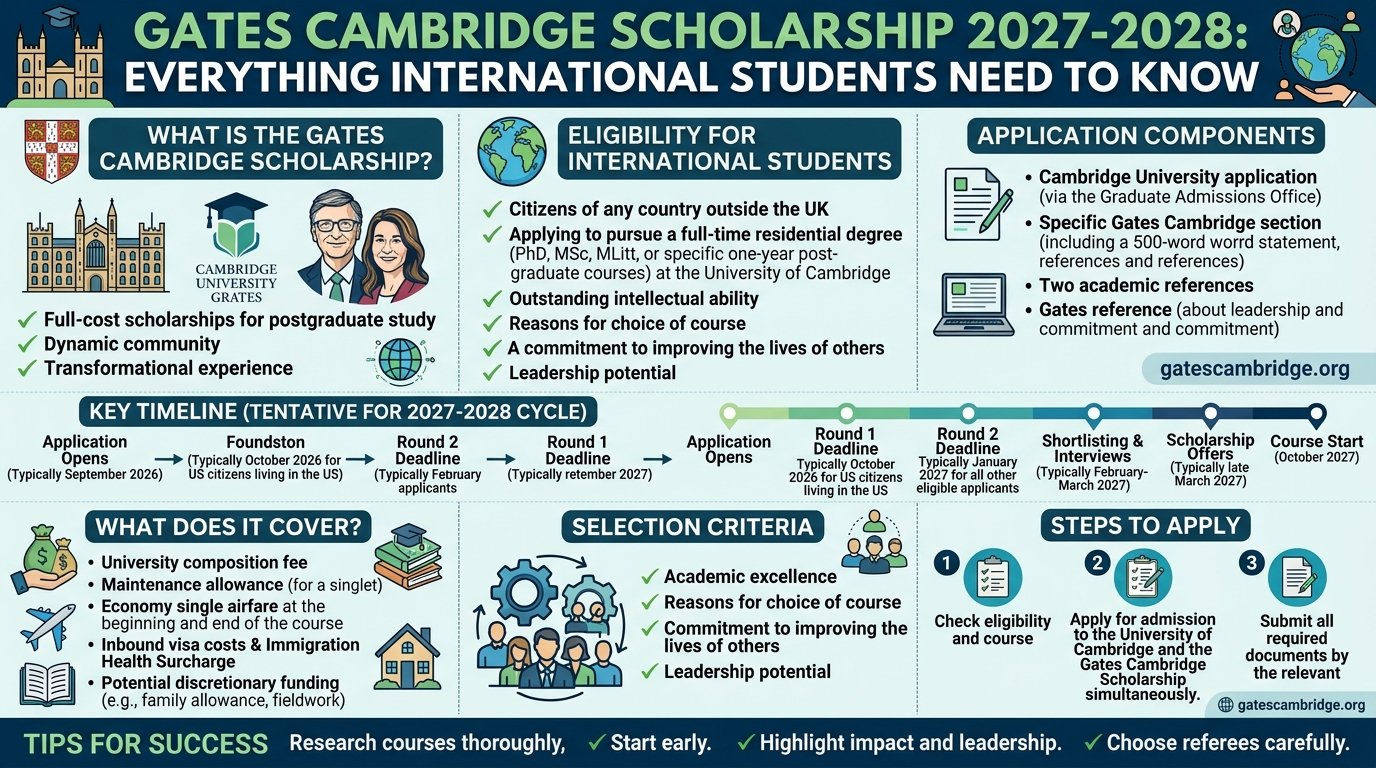
At its core, the Gates Cambridge Scholarship is a fully funded award for outstanding international students pursuing postgraduate study at the University of Cambridge. Unlike scholarships that only chip away at your tuition bill, this one is built to cover the major costs of actually living and studying there.
For the 2027–28 intake, applicants will apply through Cambridge’s standard postgraduate application system, and will also need to complete a separate, scholarship-specific section just for Gates Cambridge consideration.
It’s worth being upfront about how competitive this really is. The most recent cohort brought in 68 scholars representing 25 different countries — 51 of them PhD candidates and 17 pursuing an MPhil. On average, Cambridge awards roughly 80 Gates scholarships a year, and about two out of every three of those typically go to PhD applicants.
Gates Cambridge 2027–28 at a Glance
- Country: United Kingdom
- University: University of Cambridge
- Degree levels: Eligible Master’s and PhD programmes
- Who can apply: Citizens of any country outside the UK
- Intake: October 2027
- Applications open: September 2026
- Main international deadline: December 8, 2026
- Deadline for US-resident US citizens: October 14, 2026
- Funding: Full-cost scholarship
- Extra requirement: A dedicated Gates Cambridge reference
- What they’re looking for: Academic excellence, genuine fit with your chosen course, a real commitment to improving others’ lives, and demonstrated leadership
Which Degree Levels Qualify?
The scholarship covers eligible Master’s and PhD programmes at Cambridge. Your first move should be picking the specific postgraduate programme you want, then digging into that programme’s own academic and funding requirements — they’re not all identical.
If you’re applying for a Master’s, you’ll need a genuinely convincing answer for why that particular Cambridge course matters for where you’re headed next. Good grades alone won’t carry an application here — the selection committee wants to understand your reasoning, not just your transcript.
PhD applicants have a bit more groundwork to do early on. That means shaping a realistic, well-defined research question, identifying Cambridge academics whose work aligns with yours, confirming what your target department expects in terms of supervisor contact, and getting a head start on your research proposal well before deadlines hit.
What Subjects Are Eligible?
Here’s something a lot of prospective applicants misunderstand: there’s no such thing as a “Gates subject.” Past scholars have come from an enormous range of fields — health, neurodevelopment, politics, economics, engineering, technology, fundamental sciences, and plenty of other postgraduate disciplines Cambridge offers.
What actually matters isn’t picking a field you think sounds more “fundable.” It’s building a clear, honest thread connecting what you’ve already achieved, what you plan to do at Cambridge, and the impact your work could realistically have once you’re done. Chase a subject because you’re genuinely suited to it — not because you’re guessing at what selectors want to see.
What Does the Scholarship Actually Cover?
This is a full-cost scholarship, not a partial discount. Generally, the core award includes:
- The University Composition Fee
- A maintenance allowance to cover living costs
- One economy flight to Cambridge at the start of your course
- One economy flight home at the end
- Visa costs for entering the UK
- The Immigration Health Surcharge
On top of that, there’s sometimes additional discretionary funding available — things like support for academic development or assistance for scholars with dependent children. One important caveat: don’t rely on older published figures for the maintenance allowance. That number should be confirmed once the official 2027–28 scholarship call is published.
Who’s Eligible to Apply?
The scholarship is designed specifically for citizens of countries outside the UK — so if you hold UK citizenship, you fall outside this particular international applicant category for the 2027–28 cycle.
Even as an international applicant, it’s smart to double-check nationality and programme-specific rules once the official call opens, since individual departments can have their own additional requirements.
The Core Eligibility Requirements
1. You’re an eligible international applicant. This scholarship is reserved for citizens of countries outside the UK.
2. You’ve applied to an eligible postgraduate programme. You’ll need to be accepted into (or applying for) an eligible Master’s or PhD programme at Cambridge, meeting that specific programme’s own admission standards.
3. You can demonstrate real academic excellence. This is one of four pillars the selection committee weighs. Cambridge’s general postgraduate minimum tends to sit around a UK 2:1, though many programmes push that higher, expecting a High 2:1 or First-Class equivalent. There’s no officially published “winning GPA” from the Gates Trust itself — but as a rough, practical benchmark, a GPA in the 3.7–4.0 range (on a 4.0 scale) is often seen as genuinely competitive for the most selective programmes. That said, it’s a benchmark, not a cutoff.
4. You can show leadership — with evidence, not adjectives. Simply calling yourself a leader in your personal statement won’t move the needle. Selectors want concrete examples: situations where you actually led, and what came of it.
5. You’ve shown a real commitment to improving others’ lives. This is the criterion that trips up a lot of strong academic candidates. It’s not about stating good intentions for the future — it’s about pointing to what you’ve already done.
6. You have a genuine reason for choosing this specific Cambridge course. Your background, your proposed study, your career direction, and the wider impact you’re aiming for all need to connect into one coherent narrative — not four separate talking points.
7. You meet the reference requirements. Beyond your standard academic references, Gates Cambridge asks for one additional, dedicated referee. This person needs to speak specifically to your leadership, your motivation, the impact of your work, and your commitment to improving others’ lives — a generic academic reference won’t cut it here.
One more thing worth clarifying: publications aren’t a blanket requirement. If you’re applying for a research-heavy PhD, having publications can strengthen your case, but plenty of successful Gates Cambridge applicants haven’t published anything yet.
How to Actually Apply: Step by Step
Step 1: Pick your Cambridge programme. Start with the Master’s or PhD course that genuinely matches your background and where you want to go next — not the one that sounds most scholarship-friendly.
Step 2: Dig into that programme’s specific requirements. Check academic entry requirements, the funding deadline, and required documents. Don’t assume the general Cambridge admissions deadline applies to your scholarship — funding deadlines often run on their own schedule.
Step 3: Research potential supervisors (PhD applicants). Look into Cambridge academics and research groups relevant to your work before you submit anything. Some departments expect you to have already contacted a potential supervisor; others handle this differently, so confirm what your specific department wants.
Step 4: Get your documents ready. Depending on your programme, this typically includes academic transcripts, a CV, possibly a sample of written work, a research proposal, English-language test results, and any other department-specific paperwork.
Step 5: Submit your Cambridge application. Apply through Cambridge’s postgraduate application system, and make sure you indicate you’d like to be considered for Gates Cambridge funding.
Step 6: Complete the Gates Cambridge-specific section. This is separate from your general Cambridge application and asks for information the scholarship committee specifically needs.
Step 7: Line up your references early. Beyond your usual academic referees, arrange your dedicated Gates Cambridge referee — someone who genuinely knows your leadership, motivation, and broader contributions well enough to write convincingly about them.
Step 8: Draft your research proposal, if it’s required. PhD applicants especially should start this well ahead of time rather than rushing it in the final weeks.
Step 9: Submit everything before the funding deadline. For 2027–28, mark December 8, 2026 as the main international deadline, and October 14, 2026 if you’re a US-resident US citizen. Always confirm your specific programme’s deadline once applications open, since these can shift slightly by department.
A crucial reminder here: clicking “submit” doesn’t mean your application is complete. References and supporting documents still need to arrive by the deadline — so don’t leave those pieces to the last minute.
What Happens After You Apply?
It helps to understand that Cambridge admission and Gates Cambridge funding are two separate decisions that happen to be linked. It’s entirely possible to be offered a place at Cambridge without being awarded the scholarship.
Departments evaluate applicants academically first. If you progress further in the Gates Cambridge selection process specifically, you may then be invited to interview.
If you reach that stage, be ready to explain your research or proposed Master’s work to someone intelligent but outside your specific field — what you want to study, why it actually matters, why Cambridge specifically is the right environment for it, and what could realistically change if your work succeeds.
Getting Ahead of the September 2026 Opening
If you’re targeting October 2027 entry, waiting until applications open in September is cutting it close. Here’s what’s worth tackling in the months beforehand:
- Lock in your exact Cambridge programme
- Review its specific academic requirements
- Confirm the Gates Cambridge funding deadline for your department
- Honestly assess your academic competitiveness
- Build out a research question, if you’re PhD-bound
- Identify Cambridge academics whose work aligns with yours
- Check whether supervisor contact is expected before you apply
- Choose academic referees who genuinely know your work well
- Identify a strong candidate for your Gates Cambridge referee
- Get your transcripts and CV in order
- Start your research proposal, if your programme requires one
- Gather concrete evidence of your leadership and wider impact
Final Thoughts from StudyForge
The Gates Cambridge Scholarship is genuinely one of the most competitive postgraduate awards out there, and academic excellence alone won’t be enough to secure it. What sets successful applicants apart is the full package: strong grades, yes, but also a clear reason for choosing Cambridge, a real track record of improving others’ lives, and demonstrated leadership backed by evidence.
With applications opening in September 2026, the months leading up to that are exactly when the strongest applications get built — through programme research, early supervisor contact, solid references, and a genuinely coherent story about who you are and where you’re headed.
At StudyForge, we help students navigate exactly this kind of high-stakes scholarship process — from choosing the right programme to preparing a competitive application. If you’re aiming for Gates Cambridge 2027–28, now is the time to start.